ISO 14001:2026 was published on 15 April 2026, replacing the 2015 edition. Seven changes across clauses 4 to 10 carry real operational weight. The transition window closes around 30 April 2029. For MENA SMEs, the calendar is unusually sharp — the same three-year window brings the UAE Climate Law into force, makes CBAM definitive, and activates new disclosure rules in Qatar, Saudi Arabia, and Egypt. The cost of early action is SAR 30,000 to 112,500. The cost of delay is measured in lost tenders, CBAM default penalties, and fines of up to SAR 4.1 million.
The update is not cosmetic. It moves ISO 14001 from "environmental management compliance" toward a system that generates the data regulators, banks, and buyers are starting to demand. It treats climate and biodiversity as context, not commentary. It pulls suppliers and externally provided services inside the EMS. It asks the organization to evaluate whether its environmental system actually works — not only whether it is in place.
This article does three things. First, it sets out what changed, clause by clause. Second, it explains why the MENA regulatory and financing environment makes the timing unusually pressing. Third, it gives you a view of what the transition looks like in practice — the sectors most affected, the cost range, and the questions a quality manager should be asking in the next ninety days.
Exhibit 1
The transition timeline is three years. The crunch arrives earlier.
Certification bodies expect the real bottleneck in late 2028, not April 2029.
April 2026
ISO 14001:2026 published
Late 2026
First transition audits begin
Oct 2027
Last new certifications on 2015 edition
Early 2029
Last practical transition audit dates
April 2029
2015 certificates expire
The seven changes that actually matter
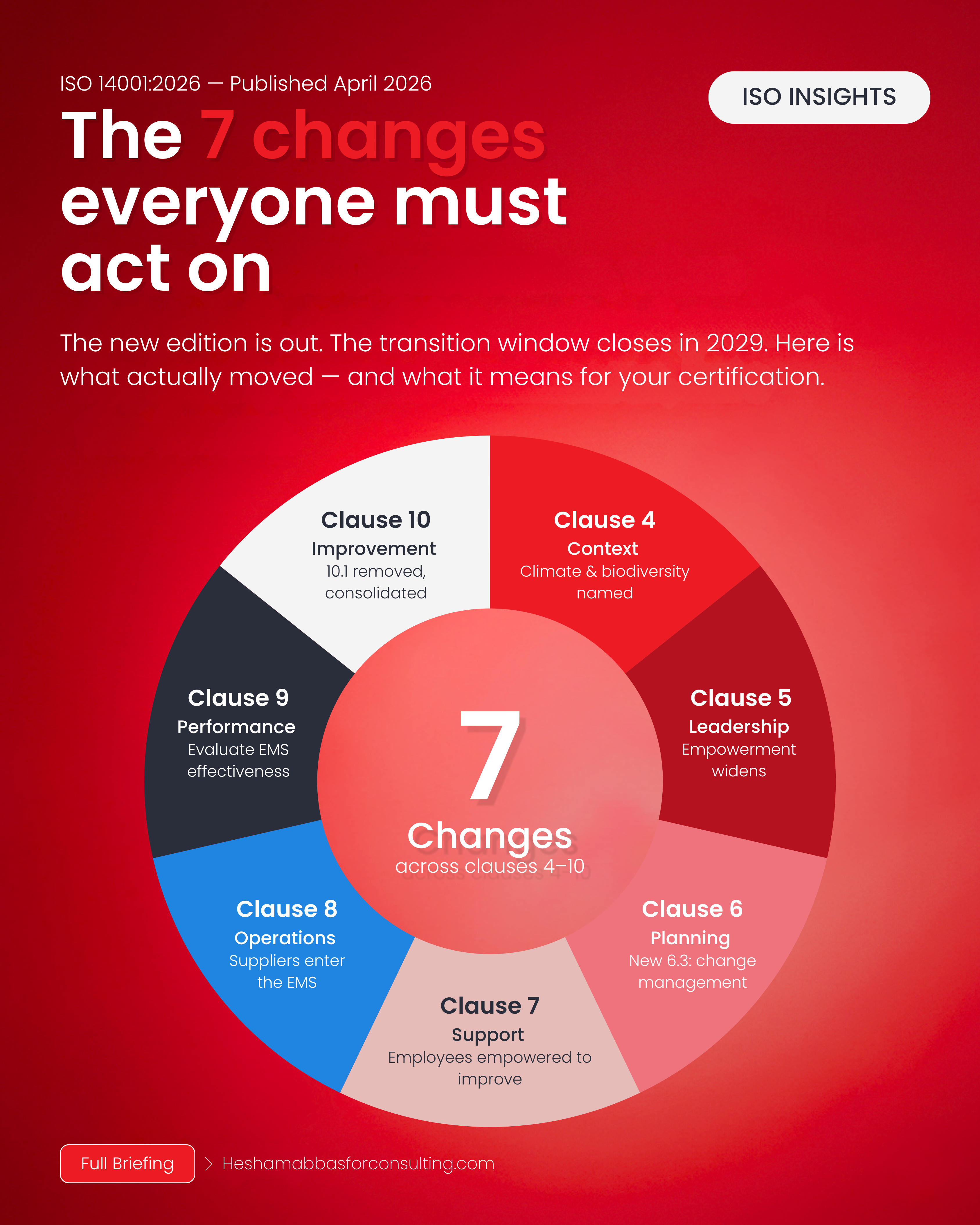
The 2026 edition keeps the Harmonized Structure familiar to anyone who works with ISO 9001 or ISO 45001. Inside it, seven shifts carry real weight. None is cosmetic. Each asks something more specific of the organization than the 2015 version did.
Clause 4 — Context
Climate and biodiversity are named, not implied
The 2015 standard asked organizations to consider "environmental conditions." The 2026 text names them directly: climate change, biodiversity, ecosystem health, pollution levels, and natural-resource availability. The EMS scope must now apply a life-cycle perspective, not only a site boundary.
What this means
Boilerplate context registers will fail audit. Every register needs sector-specific commentary on climate, biodiversity, and resource scarcity.
Clause 5 — Leadership
Leadership extends beyond managers
"Fulfil compliance obligations" is replaced with "meet compliance obligations," aligning language across ISO standards. More importantly, top management must now support persons in "all relevant roles" — not only managers. The environmental policy must commit explicitly to protecting natural resources and ecosystems.
What this means
Operators, procurement staff, and supervisors are inside the EMS now. Policy statements need a real ecosystem commitment, not pollution-only wording.
Clause 6 — Planning
A new change management clause — and no more "reasonably foreseeable"
Clause 6.3 is new. It requires planning for changes that affect the EMS — new products, new sites, M&A, supplier switches. Emergency situations are separated from abnormal operations, and organizations must now identify "all potential" emergencies, not only "reasonably foreseeable" ones.
What this means
Every MENA operator needs a Management of Change procedure. Emergency registers must cover climate-amplified events: flooding, sandstorms, extreme heat, loss of containment.
Clause 7 — Support
Communication becomes a two-way system
Documented information is now consistently phrased as "available as documented information," distinguishing mandatory records from supporting material. Communication must actively empower employees to contribute to continual improvement — not broadcast to them.
What this means
Your communication procedure needs feedback loops that reach Clause 10. Toolbox talks without a return channel no longer qualify.
Clause 8 — Operations
Your supply chain is now inside the EMS
The single biggest commercial change. "Outsourced processes" is replaced with "externally provided processes, products or services." Operational control must be proportionate to each external provider's relevance to environmental outcomes. Emergency preparedness must trace cleanly back to the risks identified under Clause 6.1.2.
What this means
Procurement, contracts, and supplier management are now EMS functions. 3PLs, contract farmers, waste handlers, co-packers, subcontractors — all need documented control or influence mechanisms.
Clause 9 — Performance evaluation
You must evaluate the system, not just the environment
Clause 9.1 now requires evaluation of environmental performance and EMS effectiveness. Internal audits must define objectives in addition to scope and criteria. Management reviews are restructured into three explicit sub-clauses: inputs, process, results.
What this means
Internal audit templates that only cover conformance will fail. Management reviews need a restructured agenda with mandatory inputs — not discretionary ones.
Clause 10 — Improvement
Improvement is consolidated and traceable
The former Clause 10.1 is removed. Its content folds into 10.2 (nonconformity and corrective action) and 10.3 (continual improvement). Root-cause analysis is expected to be tighter. Improvement actions must be traceable back to Clause 9 findings.
What this means
Every improvement action needs a clear upstream trigger — an audit finding, a monitoring excursion, a management review decision. Disconnected action logs will not pass.
"The 2026 edition asks a different question than the 2015 version. Not 'do you have an environmental management system?' but 'does it actually work, and can you prove it?'"
— HAC ISO & Quality Practice
Why MENA SMEs cannot wait
Four regulatory and commercial forces are converging on the same three-year window. Each, on its own, would push ISO 14001 from "useful certificate" toward "operational prerequisite." Together, they make the 2026–2029 period the single most consequential compliance window the region has faced.
01
The regulatory wall is now real
The UAE Climate Law requires full compliance by May 2026. Saudi Arabia's Environmental Law carries fines up to SAR 30 million. Egypt's FRA Decisions 107, 108 and 36/2026 mandate Scope 1 and 2 disclosure.
SAR 4.1MUAE Climate Law fine ceiling per repeated violation
02
CBAM is the export gate
The EU Carbon Border Adjustment Mechanism entered its definitive phase in January 2026. Egyptian aluminium, steel, fertilizer, and cement exports face immediate CBAM certificate costs. Without verified emissions data, exporters pay default values — deliberately punitive.
SAR 1.64MCBAM liability on one 10,000-tonne urea shipment
03
Supply chain cascade is already operative
Aramco IKTVA, ADNOC ICV, SABIC EcoVadis assessments, Majid Al Futtaim's Collaborative Impact Goals, and the Hospitality Alliance for Responsible Procurement all cascade environmental requirements to Tier-1 and Tier-2 MENA suppliers.
~68%of 2025 Aramco tenders required ISO certifications
04
Green finance rewards the certified
GCC sustainable bond issuance reached SAR 42.8 billion in 2025. Sustainability-linked loans in the region now price in 15–30 bps step-downs tied to verified environmental KPIs. ISO 14001 is the cleanest evidence base.
SAR 562K/yrSLL saving on a SAR 37.5M facility at 30 bps
The quiet risk
None of these four forces require ISO 14001 by name. They require the data and governance that ISO 14001:2026 is now structured to produce. The 2015 edition could be implemented as a parallel system — compliance on the side. The 2026 edition is designed to be load-bearing.
That is why organizations that treat this as a paperwork update will underinvest and fall behind. The organizations moving first are treating it as an operational upgrade, with the certificate as a by-product.
SAR 30K–112K
The total three-year transition cost for a typical MENA SME — consulting, training, certification body fees, and internal audit. Payback is typically under two years on utilities and waste savings alone.
What changes in six priority sectors
The revision lands differently depending on what you do. The six sectors below cover roughly 85% of MENA SME activity and each has a distinct transition priority.
F
Food & beverage
Contract farmers, refrigerated 3PLs, halal slaughterhouses, co-packers now inside EMS scope. Clause 4 forces groundwater and wadi-impact documentation.
SAR 46–61K · Payback < 12 months
M
Manufacturing
"All potential emergencies" language forces coverage of tank overtopping, dust explosions, solvent fires. Third-party waste treatment and lab monitoring formally in scope.
SAR 56–94K · Payback < 18 months
C
Construction
Biodiversity requirement sharpens for NEOM, Red Sea, Saadiyat. Subcontractor control becomes mandatory. Clause 6.3 tracks design variations.
SAR 71–122K · Saves SAR 1.1–3.8M per SAR 190M project
L
Logistics & transport
Owner-operator subcontracted trucks must sit inside the EMS — documented Euro standards, eco-driving training, fuel KPIs. Climate-risk routing added.
SAR 75–131K · 8–12% fuel savings typical
H
Hospitality & tourism
Coral, mangrove, and desert-ecosystem biodiversity now in context register. F&B, laundry, amenities, boat operations all in scope.
SAR 61–102K · Saves SAR 510–714K/yr
O
Oil & gas, petchem
Most transformed sector under Clause 8. Process-safety expectations harden. Clause 6.3 formalizes Management of Change across every SME supplier.
SAR 150–300K · One prevented spill saves SAR 1.9–19M
What to do in the next ninety days
The organizations that pay least and capture most in this transition are the ones that start now. The window until mid-2028 is when auditor capacity is available, certification body pricing is stable, and gap analysis work can proceed without pressure. Waiting until late 2028 means queuing for scarce audit slots at premium rates.
The first ninety days are about diagnosis, not redesign. Here is what that looks like in practice.
Diagnostic checklist
Five questions your EMS manager should answer this quarter
- Does your context register explicitly name climate change, biodiversity, ecosystem health, pollution levels, and resource availability — with commentary specific to your sector and sites?
- Do you have a documented Management of Change procedure (new Clause 6.3), tested against a real recent change?
- Are your externally provided processes, products, and services mapped, classified by EMS relevance, and assigned proportionate controls — including procurement and contracting?
- Do your monitoring KPIs and internal audit templates separately address environmental performance and EMS effectiveness?
- Is your management review restructured into inputs, process, and results — with mandatory inputs documented?
If the answer to three or more is "not fully," the transition will require meaningful work — not an update. That is still manageable in the three-year window. It is not manageable in a six-month rush.
The decision facing the MENA SME CEO
The real date that matters is not 30 April 2029. It is the decision to start. Every month of delay compounds at least four costs: regulatory exposure, supply-chain disqualification, green-finance pricing disadvantage, and CBAM default penalties. Every month of early action compounds the same four, in reverse.
The 2026 edition is the operational bridge between where MENA SMEs are today and where regulators, financiers, and buyers already expect them to be. The organizations that cross that bridge first will spend the rest of the decade competing on better terms.
Work with HAC
Start your transition before the capacity crunch arrives.
HAC has led organizations across the GCC and Egypt through ISO 14001 certification for more than two decades — Hesham Abbas brings 35+ years of regional ISO expertise, including 23 years building certification practice at Intertek. We run clause-by-clause gap assessments, implementation, and lead audits without a single failed certification.
About this briefing. This is part of HAC's ISO Insights series, written for MENA SME leaders navigating the 2026 regulatory environment. Our analysis draws on the official ISO 14001:2026 standard, IAF and GACI transition guidance, certification body communications (SGS, Bureau Veritas, Intertek, DNV, BSI), regional regulatory texts, and HAC's own client engagement experience across the GCC and Egypt.
About HAC. Hesham Abbas for Consulting is a Bahrain-headquartered management and quality consulting firm operating across the GCC and Egypt. We help organizations achieve operational excellence through ISO certification, process improvement, strategy, and leadership development.
© Hesham Abbas for Consulting (HAC). All rights reserved.