

Between 60% and 90% of strategic plans never fully launch. For SMEs in the Middle East, where resources are leaner and the margin for error is thinner, this gap between strategy and execution isn't just costly — it's existential.
Between 60% and 90% of strategic plans never fully launch. Ninety-five percent of a company's employees are unaware of, or do not understand, its strategy. And 48% of leaders spend less than one day per month discussing it. These are not edge cases — they are the norm. For SMEs in the Middle East, where resources are leaner and margins for error are thinner, this gap isn't just unfortunate. It's existential.
The confidence gap
14%
of executives feel confident in strategies that go unchallenged
4.3×
more confident when strategies are externally reviewed or stress-tested
60%
confidence among leaders who subject strategy to structured challenge
Only 14% of executives feel confident in strategies that go unchallenged. But those who subject their strategies to consulting or structured internal review are 4.3 times more confident in their success — jumping to 60% confidence. The implication is clear: strategy developed in isolation fails. Strategy that is stress-tested, challenged, and built with execution in mind from day one has a fundamentally different success rate.
Source: National Center for The Middle Market, 2019
Why strategies stall
The data tells a consistent story. 95% of employees don't understand their company's strategy (Harvard Business Review, 2005). 48% of leaders spend less than one day per month discussing strategy (Harvard Business School, 2020). If leadership isn't spending time on strategy and the workforce doesn't understand it, execution becomes impossible — not because the plan was wrong, but because no one is carrying it.
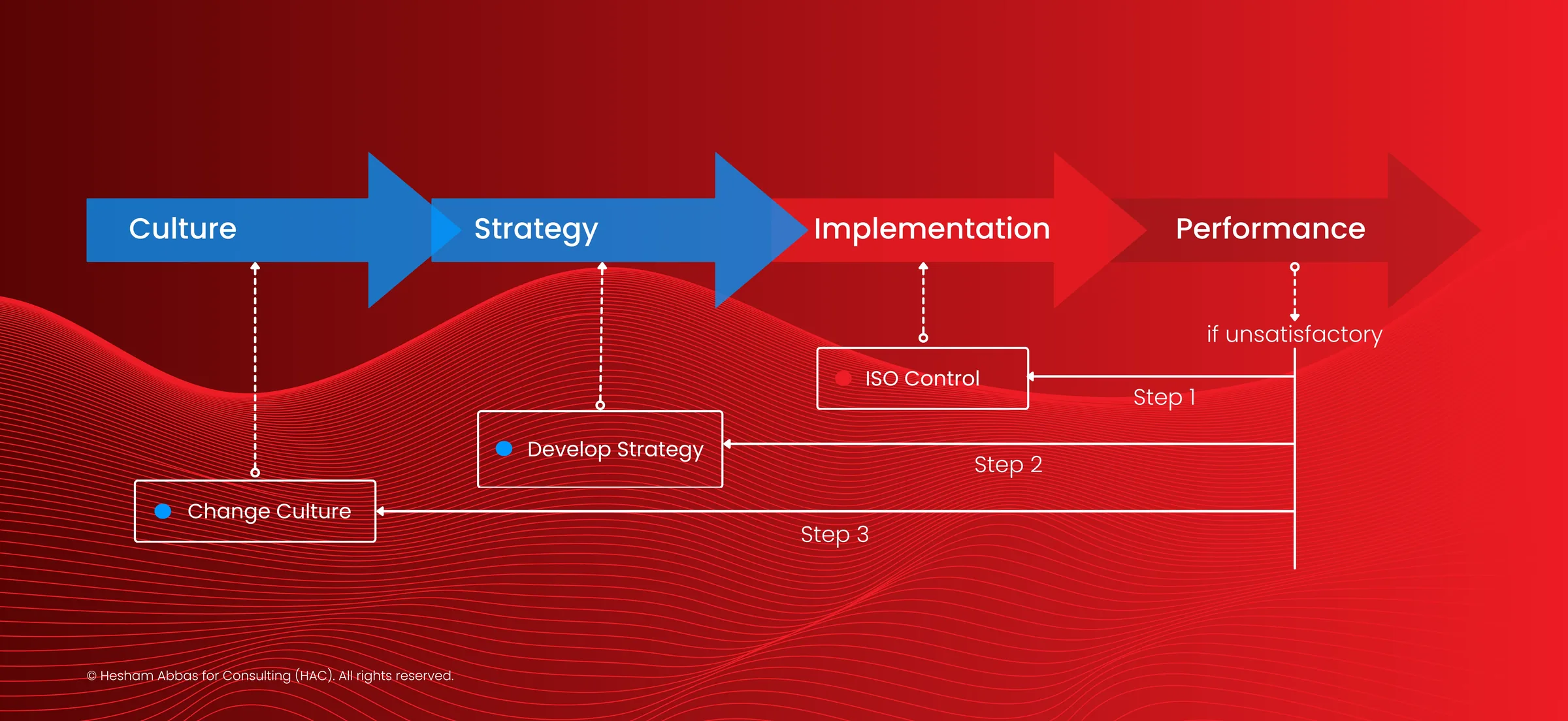
Most strategies fail at the handoff. A leadership team defines the vision and the growth initiatives, then hands a document to the organization and expects execution to follow. It doesn't. The gap between "what we decided" and "what actually happens on the ground" is where value is destroyed.
Framework
From culture to performance — and where the breakdown occurs
Source: HAC analysis
"90% of organizations fail to execute their strategies. Our advisory work is structured to support clients across the full cycle — ensuring strategy is not only well-defined, but effectively executed and sustained over time."
What winning companies have in common
The companies that close the execution gap share a consistent set of traits. They treat strategic planning as a leadership discipline — not a once-a-year offsite exercise. They foster a culture of challenge, where ideas are pressure-tested before they become commitments. They ensure company-wide alignment so that every function understands how its work connects to the strategy. And they maintain strategic agility: adapting plans as markets shift, rather than defending documents that no longer reflect reality.
Above all, they invest in data-driven expert guidance rather than relying on instinct alone. They know that confidence without external challenge is a liability.
The HAC approach: three pillars from vision to action
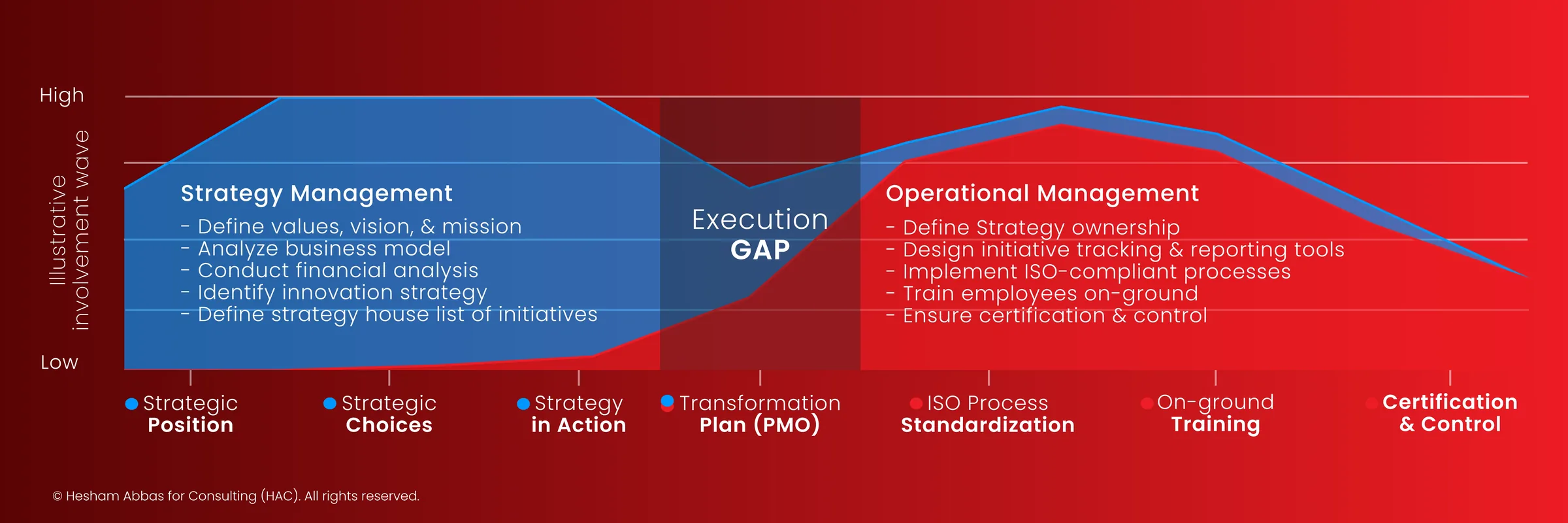
HAC's methodology is built on a MECE-based framework that translates vision into action across three sequential, interconnected pillars. This is not a theoretical model — it is the structure applied to every strategy engagement.
Framework
The HAC Strategy-to-Execution Framework
Source: HAC analysis
Understand where you are. This means analyzing the macro-environment, industry dynamics, organizational purpose, culture, and resources. It's the diagnostic foundation everything else is built on. Without an honest assessment of your starting position, every strategic choice that follows is guesswork. Most organizations skip this step or rush through it — and pay for it later.
Define where to play and how to win. This covers business strategy, corporate strategy, international management, M&A evaluation, and innovation strategy. We build growth options, entry strategies, and feasibility-driven go/no-go frameworks. The output is a clear set of prioritized initiatives with projected impact — choices made against real constraints, not aspiration.
Make it real. This is where most firms stop — and where we keep going. Strategy in Action covers organizational design, leadership and change management, practice implementation, and process standardization. We define strategy ownership, design tracking and reporting tools, implement ISO-compliant processes, train employees on the ground, and ensure certification and control. The strategy doesn't end with a deck. It ends when operations are running it.
The partnership model
HAC has partnered with Flex Labs to deliver a unified solution that connects strategy management with on-the-ground operational execution. By working together from the beginning of each engagement, we ensure strategies are not only well designed — but fully understood, aligned, and executed across the organization.
The execution gap is not a mystery. It's a structural failure that occurs when strategy and operations are treated as separate disciplines, owned by separate teams, with separate timelines. The firms that close this gap are the ones that refuse to separate them in the first place. That's the approach we take — and it's why our clients' strategies reach operations.