
80% of Middle East organizations feel intense pressure to adopt AI, but nearly half struggle to act. The gap between ambition and execution is widening — and the data increasingly points to a single root cause that has nothing to do with technology.
Across the GCC and broader Middle East, the conversation about artificial intelligence has shifted from "if" to "when" — and now to "why aren't we there yet?" The pressure is unmistakable. Boardrooms and leadership forums buzz with AI mandates. Government agendas from Saudi Vision 2030 to Bahrain's national digital agenda place AI at the center of economic transformation. And yet, for the majority of small and medium enterprises in the region, the gap between intent and execution remains stubbornly wide.
The question worth asking is not why AI is difficult to implement. The technology, in many cases, has become genuinely accessible — from cloud-based language models to off-the-shelf automation tools that require no data science expertise. The question is why so many organizations that want to act cannot seem to start. The answer, increasingly backed by data, points to leadership.
The readiness gap is a leadership gap
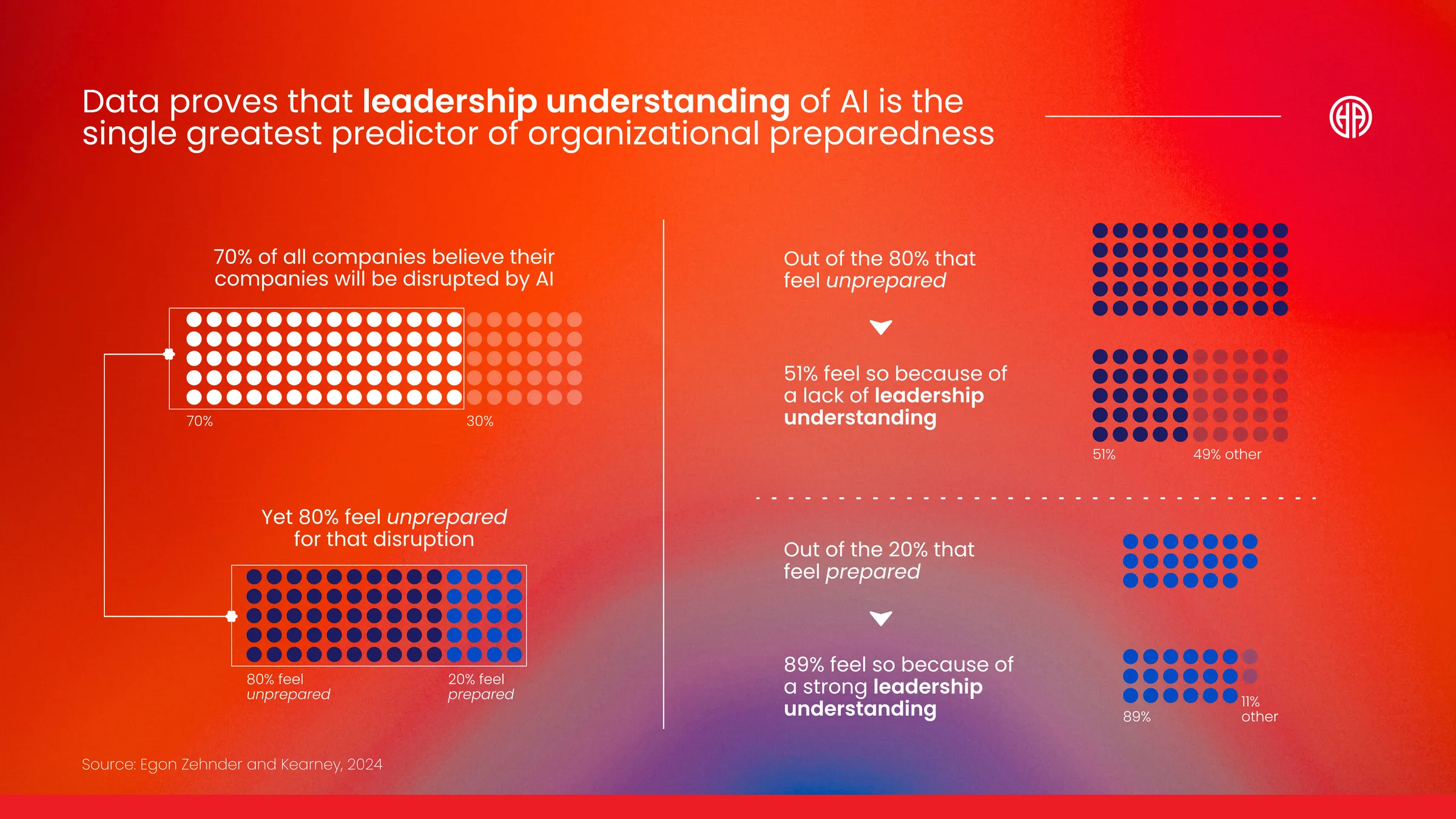
The correlation runs in both directions. Among the 20% of organizations that do feel prepared, 89% attribute that preparedness to strong leadership understanding of AI. This is not a secondary factor — it is the primary predictor of organizational readiness. More than infrastructure. More than data quality. More than budget.
The implication is direct and somewhat uncomfortable: the AI readiness problem in Middle East SMEs is not principally a technology problem or a talent problem. It is a leadership literacy problem. Leaders who do not understand what AI can and cannot do for their business are unable to make the investment decisions, build the organizational culture, or set the strategic direction that AI adoption requires.
Sources: Egon Zehnder and Kearney, 2024
"The question is no longer if to adopt AI — only how soon."
— Hesham Abbas, CEO, HAC Consulting
The barriers are strategic, not technical
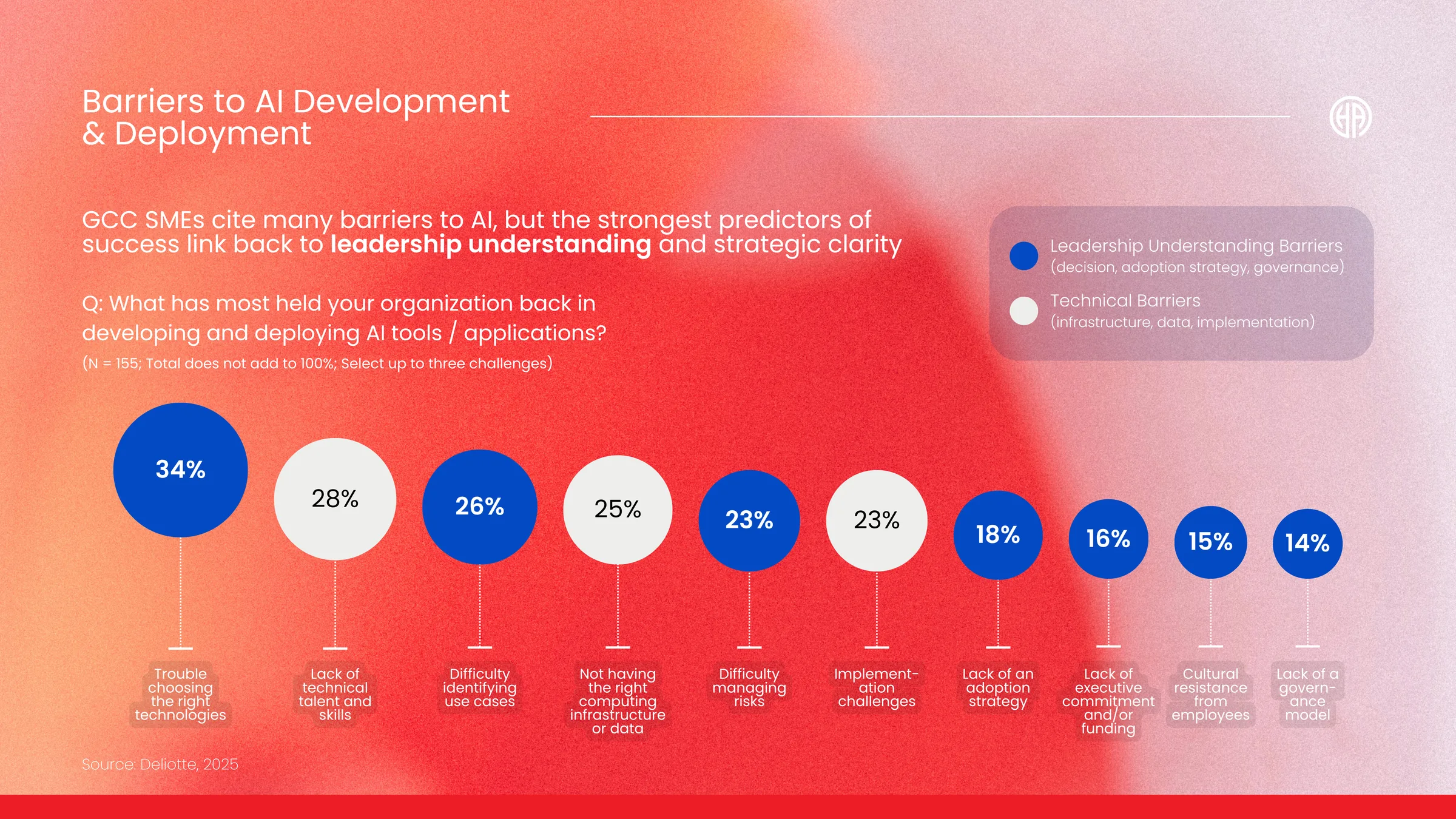
Data from Deloitte's 2025 survey of regional technology adoption breaks down the barriers organizations report when attempting AI implementation. The top three are instructive:
Source: Deloitte, 2025
The top three barriers cluster into a single category: leadership understanding failures. An organization that cannot choose the right technologies, cannot identify where AI creates value, and cannot develop adoption strategies is not facing a technical gap — it is facing a strategic clarity gap that flows from the top. The data infrastructure and talent barriers, by contrast, are genuinely technical and can be acquired once leadership provides direction.
A leadership playbook for SMEs
The organizations that have successfully closed the readiness gap share a common pattern. Their leaders moved through four fundamentals in sequence — not as a grand transformation program, but as a deliberate series of choices:
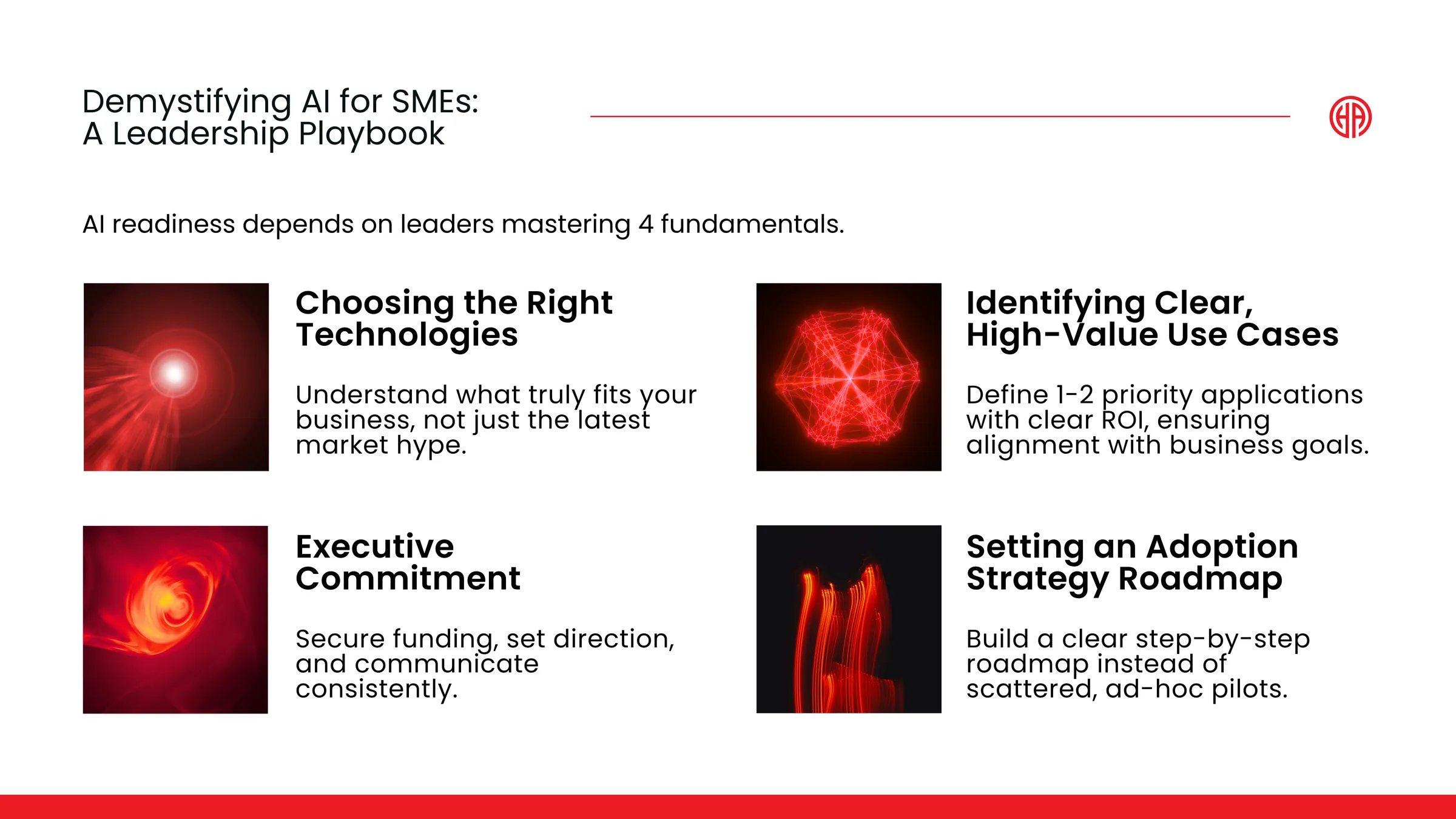
Choose the right technologies — fit over hype
Evaluate tools based on their fit with your specific business model and operational context, not their prominence in press coverage. Most SMEs should begin with workflow automation and intelligent document processing before attempting generative AI applications.
Identify 1–2 high-value use cases with clear ROI
Resist the temptation to pilot AI across multiple functions simultaneously. Identify the one or two processes where AI can deliver measurable impact within 90 days, and build credibility from a concrete success before expanding.
Executive commitment — funding, direction, communication
AI adoption stalls when it becomes an IT initiative rather than a business initiative. The CEO and senior leadership must own the agenda: allocate budget, set clear expectations, and communicate the why to the organization — not just the what.
Set a phased adoption roadmap — step-by-step, not scattered pilots
Build a 12-to-18-month roadmap that sequences AI investments logically, builds internal capability at each step, and creates feedback loops between implementation and strategy. Scattered pilots without a roadmap produce organizational fatigue, not progress.
The cost of not knowing
The cost of inaction far exceeds the cost of adoption — and that asymmetry is widening every quarter. Leaders who fail to develop AI literacy create a specific organizational pattern: employees sense the ambiguity, default to caution, and the organization collectively slows down as competitors who moved earlier build compounding advantages.
For SMEs in the GCC and MENA, this dynamic is especially acute. AI talent is scarce and competition for it among larger organizations is fierce. The window in which SMEs can attract the AI skills they need at affordable cost is narrowing. Waiting is not a neutral decision — it is a losing one, compounding quietly until the gap becomes structural.
The organizations that will define the next decade of GCC business are being built right now, by leaders who took AI seriously before it was obvious that they had to. The leaders who waited for certainty found that certainty arrived in the form of a competitor's advantage, not their own.
AI readiness for SMEs does not start with buying software or hiring data scientists. It starts with leaders who understand what AI can and cannot do for their business, and who commit to learning before deciding. The firms that will thrive are the ones whose leadership treats AI literacy as seriously as they treat financial literacy — not as a technology question, but as a fundamental leadership responsibility.