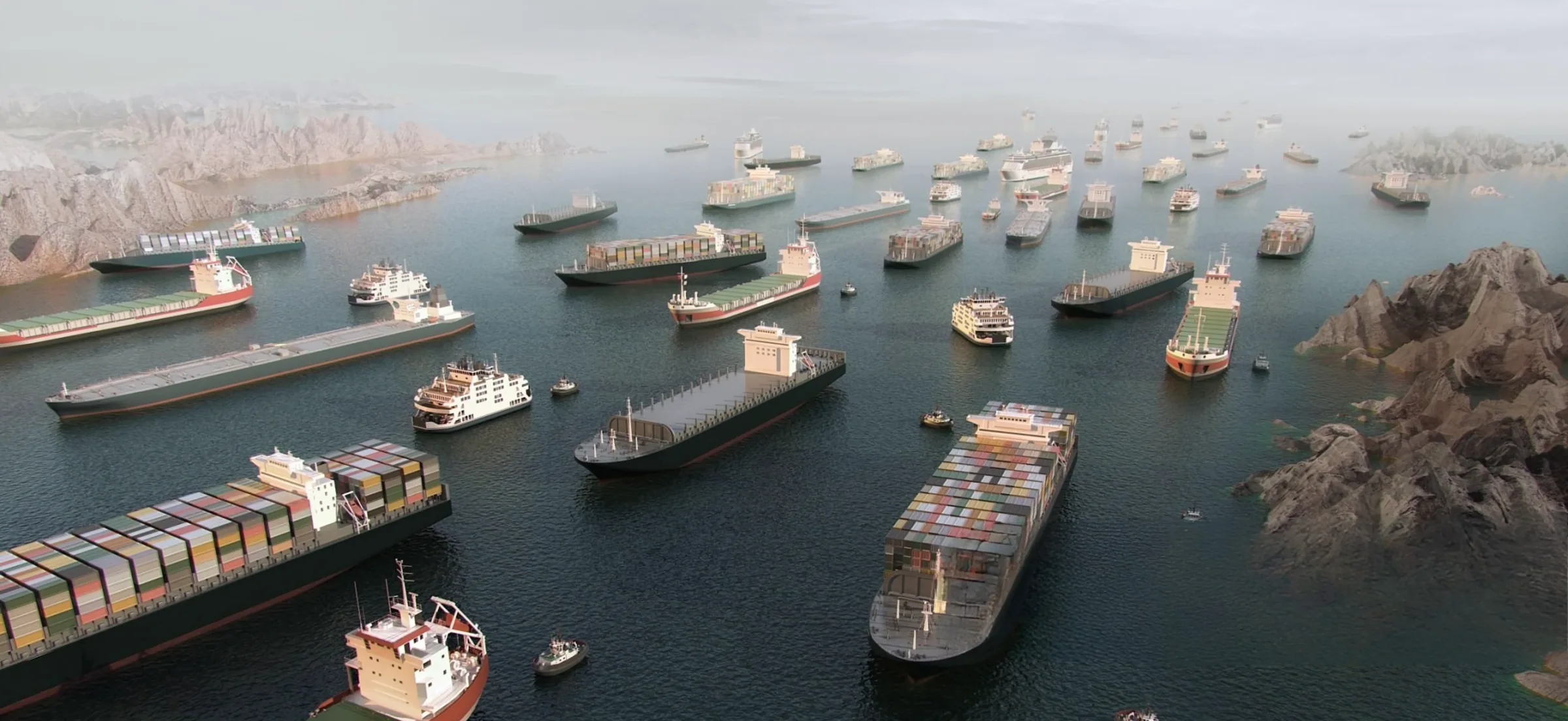
The Strait of Hormuz closure triggered by the Iran-US war has created the most severe energy supply disruption in recorded history — but the damage is far from uniform. A new HAC index reveals that different industries face vastly different levels of disruption, and their ability to recover varies even more.
Brent crude surged 88% in the weeks following the conflict's escalation. Thirty-four or more force majeure declarations have been filed across the petrochemical supply chain alone. Insurance underwriters have suspended cover for Gulf-transiting vessels. And yet, amid this turmoil, some sectors are seeing demand surge while others face existential operational halts. That asymmetry is precisely what the HAC Iran-US War Disruption Index is designed to capture and quantify.
The index does not attempt to predict the war's duration or political resolution. It is a decision tool — a structured way for business leaders to locate their industry relative to two axes that matter most right now: how severely the conflict has disrupted operations, and how quickly recovery can realistically occur once conditions normalize.
Not all disruptions are equal
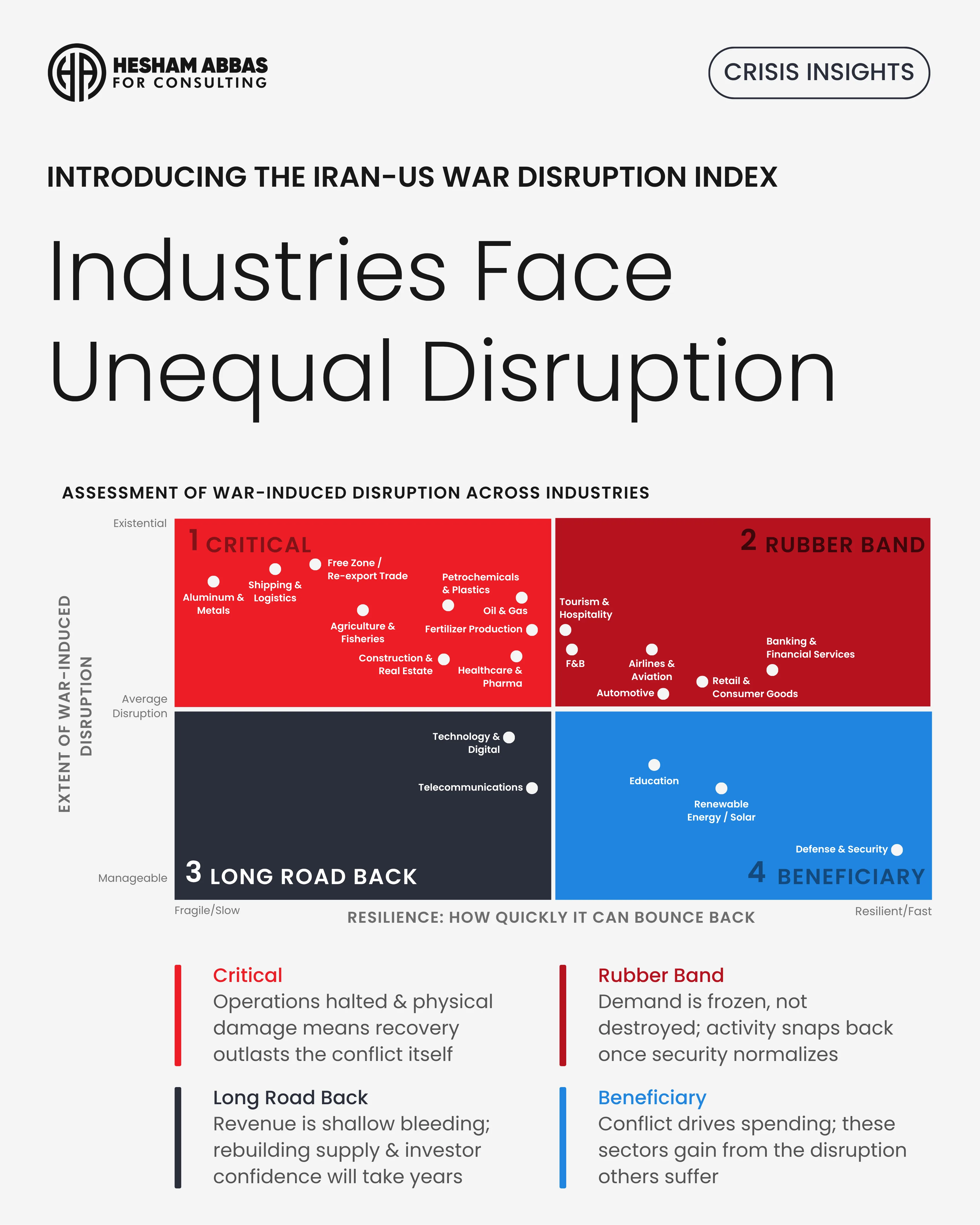
The framework maps industries across two dimensions. The vertical axis measures the extent of war-induced disruption — ranging from manageable headwinds at the low end to existential operational halts at the high end. The horizontal axis captures resilience and speed of recovery: how quickly, once security normalizes, an industry can restore volume, supply, and investor confidence. Together these axes create four quadrants with meaningfully different strategic implications.
Exhibit
Assessment of war-induced disruption across industries
Source: HAC analysis
Quadrant 1 — Critical
Operations halted and physical damage means recovery outlasts the conflict itself.
Aluminum & Metals · Shipping & Logistics · Free Zone / Re-export Trade · Petrochemicals & Plastics · Agriculture & Fisheries · Oil & Gas · Fertilizer Production · Construction & Real Estate · Healthcare & Pharma
Quadrant 2 — Rubber Band
Demand is frozen, not destroyed; activity snaps back once security normalizes.
Tourism & Hospitality · Banking & Financial Services · F&B · Airlines & Aviation · Automotive · Retail & Consumer Goods
Quadrant 3 — Long Road Back
Revenue is shallow bleeding; rebuilding supply and investor confidence will take years.
Technology & Digital · Telecommunications · Education
Quadrant 4 — Beneficiary
Conflict drives spending; these sectors gain from the disruption others suffer.
Defense & Security · Renewable Energy / Solar
What this means for business leaders
The index is not academic — it is a decision tool. Where your industry sits in this matrix determines the nature of the response required. For leaders in Quadrant 1, the imperative is survival: secure alternative supply chains immediately, lock in forward volumes wherever capacity exists, preserve cash, and stress-test every assumptions about six-month operating runway. Time is not neutral here.
For Quadrant 2 sectors — those in the Rubber Band — the risk is over-reaction. Their demand is frozen, not destroyed. Customers who cannot travel or spend today will return when security conditions stabilize. The companies that will win in these sectors are those that hold capability and maintain client relationships through the disruption rather than cutting to the bone and losing the workforce and systems needed for rapid reactivation.
Quadrant 3 requires a different posture entirely: patient, strategic repositioning. Revenue bleed is shallow but sustained, and investor confidence will not return quickly. Leaders here need to make hard choices about which capabilities to protect, which markets to pause, and how to sequence re-entry as confidence gradually rebuilds.
"The companies thriving in this crisis are those with non-Gulf feedstock sources and the financial reserves to buy raw material when others cannot."
Quadrant 4 sectors — Defense & Security and Renewable Energy — represent a genuine strategic window. Conflict is accelerating government spending in both categories, and companies in these spaces should be moving to lock in long-term contracts, expand capacity, and position for the policy tailwinds that will outlast the immediate crisis.
A chokepoint that was never priced in
The Hormuz disruption has exposed a fundamental structural vulnerability in GCC and MENA economies: the concentration of energy and commodity flows through a single maritime chokepoint creates asymmetric risk that most businesses had never seriously modeled. Risk frameworks built on historical volatility systematically underestimated this scenario precisely because it had never happened at scale before.
The index provides a starting point for any leadership team trying to understand where they sit — and what to do about it. Disruption severity tells you how urgent your response needs to be. Recovery readiness tells you whether you need to be playing defense or positioning for the rebound. Knowing the difference could define which companies emerge from this period stronger, and which do not emerge at all.